
Last updated: July 2026
by Jess Knauf, Director of Client Strategy at Mediate UK. Reviewed by Belinda Atkins, Managing Director, Family Legal Ltd. This blog is written in accordance with our editorial standards. Information is current as of 15 July 2026.
Key Takeaways
- The EX160 form is the paper application for the government’s Help with Fees scheme, which can reduce or waive a court fee in England and Wales.
- You can apply if you are on certain benefits, have a low income, or have little in savings. It covers family court fees such as divorce, a C100 or a consent order.
- For most family applications, you must have less than £4,250 in savings, and a single applicant needs a monthly income below £1,420 (plus an allowance for each child) for a full waiver.
- You can apply online for an instant reference, or on paper with the EX160 if you prefer. There is no fee to apply.
- Mediation avoids most court fees in the first place, and mediation itself can be free if you qualify for legal aid.
EX160 Form
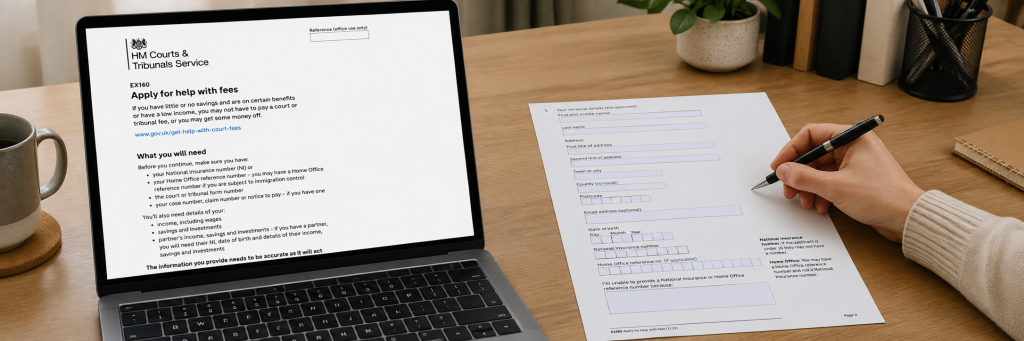
The EX160 form is the paper application for Help with Fees, the scheme that lets you apply to have a court or tribunal fee in England and Wales reduced or waived. It is run by HM Courts and Tribunals Service, and you can apply on the form or online at the same time as you start your case. Whether you pay nothing, part, or the full fee depends on your income, your savings and any benefits you receive.
If a court fee is standing between you and sorting out your divorce or arrangements for the children, the EX160 form could take some or all of that cost away. It is the paper application for the government’s Help with Fees scheme, and it exists so that money is not the reason someone cannot start family court proceedings. Divorce, a financial order and a children application all carry a fee, and those fees have just gone up, so knowing how to apply for help matters.
Before you reach that stage though, it is worth knowing that many separating couples sort things out without a judge and never pay most of these fees at all. This guide explains what the EX160 form is, exactly who qualifies for help with court fees, the current 2026 income and savings limits, and how to apply step by step.
What Is the EX160 Form and What Does It Cover?
The EX160 form is the official application for Help with Fees, a scheme that is sometimes called fee remission or a fee exemption. It is administered by HM Courts and Tribunals Service (HMCTS) and applies to courts and tribunals in England and Wales. When you make a court application that carries a fee, you can apply for help with that fee at the same time.
There are three related documents, and it helps to know which is which:
- EX160: the application form itself, which you fill in and send to the court.
- EX160A: the government guidance that walks you through who qualifies and how to complete the application.
- EX160C: the fee remission calculator, which works out roughly how much, if anything, you would need to pay.
Only individuals can apply, including sole traders. If your application succeeds, the fee is either waived in full or reduced, based on your financial circumstances. You can download the current version from the GOV.UK Help with Fees page, or apply online for a faster decision.
Which Court Fees Can the EX160 Form Help With?
Help with Fees covers most family court fees. These are the fees people most often ask us about, using the figures that apply from 13 July 2026:
| Family court application | Court fee (from 13 July 2026) |
| Divorce or dissolution application | £628 |
| Child arrangements, specific issue or prohibited steps (the C100) | £270 |
| Financial order on notice (the Form A that starts financial proceedings) | £321 |
| Financial order by consent (a consent order, including a clean break) | £62 |
Fees are set by the government and change from time to time. These figures are the family court fees from 13 July 2026, taken from GOV.UK, as of July 2026. You can read more about each stage in our guides to getting a divorce and to a financial consent order. A separate application needs a separate Help with Fees application, so if you are filing both a divorce and a consent order, that is two applications.
Do I Qualify for Help With Court Fees?
Three things decide whether you qualify for help with court fees: the benefits you receive, your savings and investments, and your monthly income. You can qualify through any of these routes, and the assessment looks at all three together. If you have a partner, their income and savings usually count too, unless your case is against them.
Can You Get Help With Fees If You Receive Benefits?
If you receive one of these benefits and your savings are within the limit, you should qualify for a full fee waiver:
- Income-based Jobseeker’s Allowance (JSA)
- Income-related Employment and Support Allowance (ESA)
- Income Support
- Universal Credit, where you earn less than £6,000 a year
- Pension Credit (guarantee credit)
The court checks your benefit status with the Department for Work and Pensions, so you usually do not need to send proof unless they ask for it.
How Do Savings and Investments Affect Your Application?
Your savings and investments (the scheme calls this your disposable capital) must be below a set limit, and the limit depends on the size of your court fee. Because family court fees are all under £1,420, the £4,250 threshold applies to most family applicants:
| Your court fee | Savings must be under |
| Up to £1,420 (covers all common family fees) | £4,250 |
| Between £1,421 and £5,000 | 3 times your court fee |
| £5,001 or over | £16,000 |
Savings include money in bank accounts and ISAs, investments, bonds, stocks and shares, cryptocurrency, and any lump sum such as a redundancy payout. If you or your partner are aged 66 or over and have less than £16,000 in savings, you may still get help. Certain compensation payments, personal pensions and student loans are left out of the total.
What Are the Income Limits for Court Fee Remission?
If you are not on a qualifying benefit, your monthly income decides whether you get a full waiver, a partial one, or nothing. For a full waiver, your gross monthly income must be below these amounts:
- Single: less than £1,420 a month, plus £425 for each child aged up to 13, and £710 for each child aged 14 or older.
- Couple: less than £2,130 a month, plus the same allowance for each child.
So a single parent with one child under 13 can earn up to £1,845 a month and still get a full waiver. A single parent with one child aged 14 or older can earn up to £2,130. If your income is above the full-waiver figure, you may still get a partial remission: the cut-off for that is £4,420 a month for a single applicant, or £5,130 for a couple, again with the child allowances added on. The EX160A guidance sets out the full rules.
“We see a lot of people assume they earn too much to get help, then find they qualify for a partial waiver once they add in an allowance for each child. It costs nothing to apply, so if a court fee is a worry, it is always worth checking before you rule yourself out.”
Jess Knauf, Director of Client Strategy, Mediate UK
How Do You Apply Using the EX160 Form?
You can apply online or on paper. Online is usually faster, and you get a reference number straight away that you add to your court application. Whichever route you choose, apply before or at the same time as you file your court form, not afterwards.
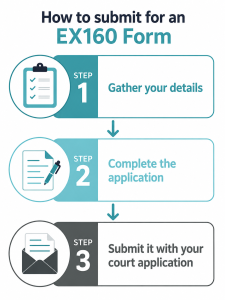
Step 1: Gather your details
You will need your National Insurance number (or Home Office reference number if you are subject to immigration control), your date of birth, details of your savings and monthly income, and the same details for your partner if you have one. If you know your court form number and case reference, have those to hand, but you can leave them blank if your case has not started.
Step 2: Complete the application
Apply on the GOV.UK Help with Fees service, or download and fill in the paper EX160. Answer the questions about your benefits, savings and income honestly. You sign a statement of truth, and giving false information can lead to fraud proceedings, so take care to be accurate.
Step 3: Submit it with your court application
If you apply online, you get a reference in the format HWF-XXX-XXX. Send this to the court within 28 days, or add it when the online court system prompts you. If you apply on paper, send the EX160 to the court handling your case within 28 days of signing it. There is no charge for applying.
Not sure whether court is even the right route?
Most separating couples settle finances and arrangements for the children through mediation, without a contested court hearing. A first meeting, called a MIAM, is the place to talk it through, and it can be free if you qualify for legal aid.
What Happens After You Apply for Help With Court Fees?
HMCTS reviews your application and your court case will not move forward until a decision is made. There are a few possible outcomes:
- Full remission: the fee is waived in full and your application is processed as normal.
- Partial remission: you are told how much to pay towards the fee, and you pay that contribution by the deadline given.
- More information needed: the court may write asking for evidence such as bank statements or payslips. You have 28 days to reply, or the application is treated as abandoned.
- Refused: you get a letter explaining why, and you then have a set period to pay the full fee.
Applications on a passported benefit can be decided within a few days. Income-based ones typically take a little longer while the checks are done. If you have already paid a fee in the last three months and think you were eligible at the time, you can apply for a refund. And if your application is refused and you disagree, you can appeal in writing by the date on your refusal letter, with a response usually within 10 working days.
Family Law Service
Need Your Consent Order Drafted Properly?
Once you have agreed how to split finances, a consent order makes it legally binding. Our sister service can draft a clean break consent order for a fixed fee, and the £62 court fee is one you may be able to reduce with the EX160.
What Are the Most Common EX160 Form Mistakes?
A refused or delayed application usually comes down to a handful of avoidable errors. These are the ones we see most often:
- Applying too late: you must apply before or at the same time as your court application, not after you have paid.
- Leaving out a partner’s details: unless your case is against them, your partner’s income and savings must be included.
- Forgetting irregular income: freelance work, cash gifts, rental income and interest all count and should be declared.
- Missing the evidence deadline: if the court asks for proof, reply within 28 days or you have to start again.
- Using an old version of the form: always download the current EX160 from GOV.UK rather than an old copy.
Could Mediation Help You Avoid Court Fees Altogether?
The EX160 form is a real help when you have to go to court, but the bigger saving often comes from not needing court in the first place. If you and your ex can agree how to divide finances and arrange things for the children, you skip the Form A fee and the C100 fee entirely. You would still pay to make an agreement legally binding, but a consent order fee of £62 is far smaller than a contested financial application.
Mediation is usually quicker and less expensive than fighting things out in court, and there is funding help too. If you qualify for legal aid, your mediation can be free, and even if you do not, the family mediation voucher scheme offers up to £500 towards the cost where child arrangements are involved. You can check your options on our costs and payments page, or read the MIAM guide to see how a first meeting works.
A real example: the fee that was never needed
A client came to us ready to file a Form A because talks with her ex had stalled. She was worried about the court fee and about how she would pay a solicitor to fight it. In mediation, the two of them reached a financial agreement over three sessions. She never filed the Form A, and the only court fee she paid was for the consent order that made the agreement binding, which she applied to reduce with the EX160.
Summary
The EX160 form is how you apply for Help with Fees, the scheme that can reduce or waive a family court fee in England and Wales. You may qualify through the benefits you receive, your savings, or your monthly income, and you can apply online for a quick decision or on paper if you prefer. For most family applications the savings limit is £4,250, and a single applicant needs a monthly income below £1,420 plus an allowance for each child to get a full waiver.
It costs nothing to apply, so if a court fee is a worry, it is worth checking whether you qualify. Better still, mediation can help you avoid most court fees in the first place, and it can be free if you are eligible for legal aid.
Frequently Asked Questions
Is there a fee to fill in the EX160 form?
No. Applying for Help with Fees using the EX160 form is free, whether you apply online or on paper. You only pay a court fee if your application is refused or you are granted a partial reduction.
Do I need to send bank statements with my application?
Not straight away. You only need to send evidence, such as bank statements or payslips, if the court writes to ask for it. If they do, you must reply within 28 days or your application will be treated as abandoned.
Can I get a refund if I have already paid a court fee?
Yes, if you paid the fee in the last three months and you were eligible for help at the time you paid. You give details of your finances as they were when you paid, rather than now.
Does my partner’s income count?
Usually yes. If you are married, in a civil partnership or living together as a couple, your partner’s income and savings are included. The exception is where your case is against your partner or they have a conflicting interest in it.
Can I still get help with fees for a divorce if I am separating from my partner?
Yes. If you are permanently separated and applying for a divorce, dissolution or annulment, you can be treated as single for the application, as long as you are not living with a new partner. That means only your own income and savings are assessed.
You Might Also Find Helpful
The Ultimate Guide to Family Mediation Read the guide |
Court Fee Increases – July 2026 Find out more |
The Family Mediation Voucher Scheme Learn more |
Mediation Costs and Payments View the page |
Worried About the Cost of Sorting Things Out?
Court fees are only one part of the picture. Mediation is usually quicker and less expensive than court, and it can be free if you qualify for legal aid. Book a MIAM to get started, or arrange a free call if you would like to talk things through first.
Our Legal Partnerships
Mediate UK works closely with trusted legal professionals to ensure your agreements are legally robust. Our partners include
DFA Law LLP (agreements managed by SRA-regulated solicitor Rachel Adams, SRA 452750),
independent barristers at St Ives Chambers (including Charmian Jackson, registered with the Bar Standards Board),
and The Family Law Consultant (managed by SRA-regulated solicitor Rhiannon Compton, SRA 600560).
These legal professionals support our clients with consent orders, independent advice, and final barrister reviews.


