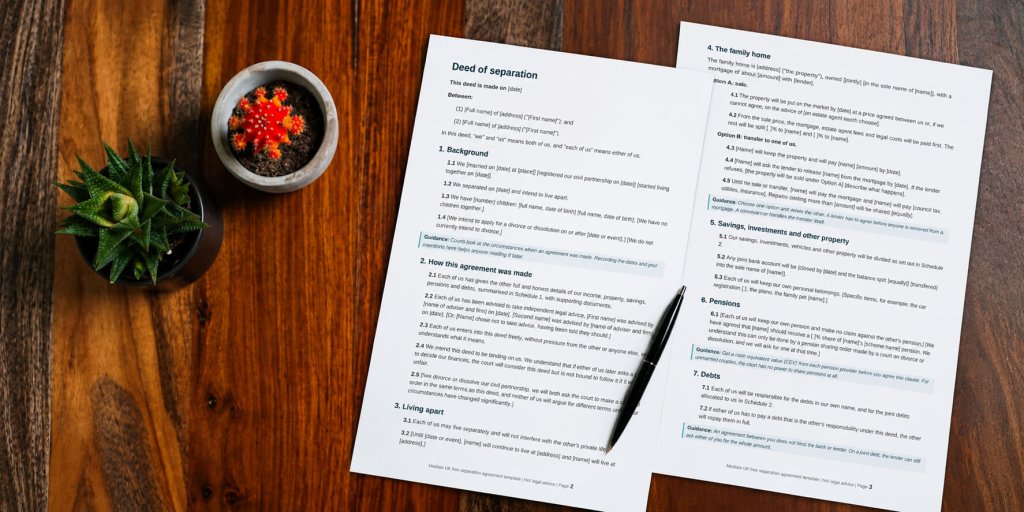
 DIY separation agreement template
Last updated: October 2026
Written by Jess Knauf, Director of Client Strategy at Mediate UK. Reviewed by Belinda Atkins, Managing Director, Mediate UK. Written in accordance with our editorial standards.
Main points
- You can write your own separation agreement in England and Wales, and our free separation agreement template below gives you a structure to start from.
- A DIY agreement suits couples with simple finances who agree on everything and trust each other’s figures.
- It should cover the home, savings, pensions, debts, maintenance and the children, backed by full financial disclosure.
- Sign it as a deed in front of an independent witness, and each take independent legal advice first.
- A separation agreement cannot share a pension or stop either parent using the Child Maintenance Service.
- If your finances are more complicated, a professionally drafted agreement is far more likely to hold up later.
CAN I WRITE MY OWN SEPARATION AGREEMENT?
Yes. A separation agreement template UK couples can use is a written record of the financial arrangements and arrangements for children you have agreed after you decide to separate. You can draft one yourselves, but it carries more weight if you both give full financial disclosure, take independent legal advice and sign it as a deed.
If you have agreed how to separate and want it in writing, a separation agreement template is a sensible place to start. This guide explains what to include, how to write each part, and how to sign it so it carries weight. You can download our free template for England and Wales further down the page, along with plain guidance on when a DIY agreement is enough and when it is not.
For the wider picture, including what a separation agreement is, whether it is legally binding and what it costs, see our complete guide to separation agreements.
On this page
- Can you write your own separation agreement?
- When does a DIY separation agreement suit?
- What should a separation agreement include?
- How to write a separation agreement, step by step
- Is a DIY separation agreement legally binding?
- Download the free separation agreement template
- How do you make it more secure?
- Frequently asked questions
Can you write your own separation agreement in England and Wales?
Yes. There is no official form and no rule that a solicitor must write it. A separation agreement, sometimes called a legal separation agreement or deed of separation, is a written contract between two people who have decided to live apart, whether married, in a civil partnership or cohabiting. It is not filed at court and there is no court fee to make one. Some couples use one because they want to remain married for now, for religious or financial reasons, and others while they wait for a divorce. What gives it weight is how it was made, not who typed it.
Cohabiting couples do not have the same financial claims as married couples and civil partners. There is no claim to maintenance for yourself or to a share of the other person’s pension, and property is usually decided by who legally owns it, so for unmarried couples a clear written agreement does more of the work. For married couples and civil partners, it sits alongside the court’s powers: if either of you later asks a court to decide your finances, the court looks at the agreement as one of the factors under section 25 of the Matrimonial Causes Act 1973, rather than being strictly bound by it. It is also different from a post-nuptial agreement, which a married couple makes while they intend to stay together.
When does a DIY separation agreement suit, and when does it not?
A DIY agreement suits couples whose finances are simple, who already agree on every point, and who can share full figures with each other. It is riskier where there are pensions to divide, a business, significant savings, or any pressure on one person to sign. The right choice depends on your specific circumstances, and the table below sets out the difference.
| A DIY separation agreement template may be enough if | Get professional help if |
|---|---|
| You rent, or the home will simply be sold and the money split | One of you is keeping the home and buying the other out |
| You have little or no pension saving, or your pensions are of similar value | You want to share a pension, or the pensions are very different in value |
| Savings and debts are modest and easy to list | There is a business, shares, trusts or property abroad |
| You agree on every point and trust each other’s figures | One of you feels pressured, or one person controls the money |
| Child arrangements are already working well | You disagree about the children, or there are safety concerns |
A DIY agreement is not suitable if there has been domestic abuse, if one of you controls the money or feels under pressure to agree, if you think assets may be hidden, or if one of you understands the finances far better than the other. In any of these situations, take independent legal advice before agreeing anything. If you feel unsafe, the National Domestic Abuse Helpline can help. Mediation always starts with private, separate meetings, so a mediator can check whether it is safe and suitable before anything else happens.
What should a separation agreement include?
A separation agreement should record who you are, when you separated, how you made the agreement, and exactly who gets what. Our separation agreement template follows this order, with a guidance note under the clauses people most often get wrong.

Background and how the agreement was made
Start with your names, addresses, the date you married or moved in together, the date you separated and your children’s names and dates of birth. Then record that you have each given full financial disclosure, that you have each been advised to take independent legal advice, and that neither of you was pressured into signing. These sentences are often the first thing a court reads if the agreement is ever questioned.
The family home
Say whether the home will be sold or kept by one of you. If it is sold, set the timing, how the price is agreed and the percentage split after the mortgage and costs. If one of you is keeping it, say how much the other will be paid and by when. A lender has to agree before anyone comes off a mortgage, so our guide to a joint mortgage when you separate is worth reading before you fill in this clause.
Savings, debts and belongings
List each account, investment, vehicle and debt, with who keeps it. Remember that your agreement binds the two of you, not the bank: on a joint loan or overdraft, the lender can still ask either of you for the full amount. A clause promising to repay the other person if they have to cover your share gives some protection.
Pensions
A separation agreement cannot split a pension. Only a court can make a pension sharing order, and only on divorce or dissolution. You can record that you will each keep your own pension, or that you intend to ask the court for a pension share later. Ask each provider for a cash equivalent value (CEV) first. Our guide to pensions on divorce explains how the figures work.
Maintenance and the children
Record any spousal maintenance one of you will pay the other, how much, how often and when it stops. For the children, set out where they will live and how time will be shared, or attach a parenting plan. Child maintenance can be agreed in the document, and the GOV.UK child maintenance calculator gives a useful starting figure.
One limit applies whatever you write: under section 9 of the Child Support Act 1991, any term that tries to stop a parent applying to the Child Maintenance Service has no effect. Our separation agreement template says this plainly so neither of you is misled.
Writing down the children’s arrangements in detail can feel a lot to take on at once. The Divorce Circle’s free parenting plan tool is a straightforward place to start, and you can attach the result to your agreement.
Wills, reviews and disagreements
Separation does not cancel a will, and a husband, wife or civil partner can still inherit until a divorce or dissolution is finalised, so agree to review your wills. Add a clause saying when you will look at the agreement again, for example if a child’s living arrangements change, and that you will try mediation before going to court if you disagree.
Not yet agreed on everything?
A mediator can help you work through the home, money and children one step at a time, so there is something to write down. It starts with a short private meeting for each of you.
Video: What is a separation agreement? (Mediate UK on YouTube)
How to write a separation agreement, step by step
Writing a separation agreement yourselves takes six steps: share your finances, agree the terms, fill in the template, each take advice, sign it as a deed, and keep it safe. Most of the work is in the first two steps. Filling in the template is quick once you know what you have agreed.
1Share full financial information
Each of you lists your income, property, savings, pensions and debts, with recent statements. Schedule 1 of the separation agreement template is a table for this. Our guide to financial disclosure explains which documents to gather and why a court looks so closely at this step.
2Agree the terms
Go through each heading in the template and agree what happens. If you get stuck on one point, family mediation can help you settle it without either of you instructing a solicitor to argue for you. A mediator can also write up what you agree in a Memorandum of Understanding, which costs £95 + VAT per person at Mediate UK (October 2026).
3Fill in the separation agreement template
Replace every word in square brackets, choose one option where there are two, and delete clauses that do not apply. Use plain, exact wording: “the car, registration AB12 CDE” is better than “the car”. Delete the grey guidance notes before you sign.
4Each take independent legal advice
Independent legal advice is not a legal requirement, but it is strongly recommended. Each of you should show the draft to a different adviser before signing. One hour of advice is often enough to check a straightforward agreement. Mediate UK’s one-hour legal advice package with our partner family law solicitors costs £250 + VAT per person (October 2026). Record in the agreement who advised each of you and when.
5Sign it as a deed
A deed must say on its face that it is a deed, and each of you signs it in front of a witness who then signs too, as set out in section 1 of the Law of Property (Miscellaneous Provisions) Act 1989. The witness must be physically present when each of you signs, even if you sign electronically. Choose an independent adult as the witness, not a relative or new partner, and give yourselves time between receiving the final draft and signing it, so nobody can say they were rushed.
6Keep copies and act on it
Keep a signed original each, with the disclosure documents. Then do what the agreement says: close joint accounts, update wills and nominations, and set up any standing orders. An agreement both of you have followed for some time is much harder to challenge later.
“The agreements that cause problems later are rarely the ones with an unusual split. They are the ones where one person never saw the other’s pension statement, or signed the week the draft arrived. If you are doing it yourselves, slow down at the disclosure and signing stages.”
Jess Knauf, Director of Client Strategy, Mediate UK
Is a DIY separation agreement legally binding?
A separation agreement can create legally enforceable obligations between you, but it is not the same as a court-approved financial consent order.
If you are married or in a civil partnership, the family court is not automatically bound by your agreement when deciding financial arrangements on divorce or dissolution. However, it may give the agreement considerable weight, particularly where you both entered into it freely, understood its implications, provided full financial disclosure and had the opportunity to obtain independent legal advice.
The courts have considered the importance of agreements between separating couples in cases including Edgar v Edgar [1980] and Radmacher v Granatino [2010]. Whether an agreement should be upheld will depend on the circumstances, including fairness and the needs of any children.
For unmarried couples, a properly prepared separation agreement may be enforceable under ordinary contract law, subject to the nature of its terms. However, it cannot replace the legal steps needed to transfer property or change mortgage responsibilities. Our guide to making mediated agreements legally binding explains the options.
Signing an agreement as a deed may provide additional legal certainty, but it does not guarantee that every clause will be enforceable or prevent future court proceedings.
For these reasons, both people should obtain independent legal advice before signing, even where they agree on everything.
Download the free separation agreement template
Our free separation agreement template for England and Wales is a deed of separation with every clause described above, guidance notes, signature blocks for you and your witnesses, and three schedules for disclosure, who keeps what and the children’s arrangements. It comes as an editable Word document and a printable PDF, with no sign-up.
Free download
Separation agreement template (England and Wales)
Nine pages, October 2026 version. Read the first page before you start: it explains what a template cannot do.
How do you make a separation agreement more secure?
There are two ways to give your agreement more weight than a DIY document. If you are married or in a civil partnership and later divorce, you can ask the court to approve the same terms as a legally binding consent order as part of your divorce proceedings. A judge reviews the terms independently and can ask for more information or decline to make the order if it does not look fair. The court fee for a consent order is £62 (from 13 July 2026), as set out in the Ministry of Justice announcement of the July 2026 court fees. Our consent order guide explains the process.
The second is to have the agreement drafted professionally from the start. Our fixed-fee separation agreement service costs £1,099 + VAT per person (October 2026). It includes separate meetings with a mediator, up to four hours of mediation on your finances, and a deed of separation drafted by our partner family law solicitors for you both to sign. Mediate UK has helped separating couples since it was founded in 2011, holds a Legal Aid Agency contract for family mediation, and has 715+ 5-star reviews.
If money is tight, you may be eligible for free mediation through legal aid. The quickest way to find out is our legal aid eligibility checker.
What to do next
If you agree on everything and your finances are simple, download the separation agreement template, work through the disclosure schedule together and book independent advice before you sign. If you are not there yet, the first step is to book a MIAM (Mediation Information and Assessment Meeting), a private meeting with a mediator to see whether mediation can help you reach terms worth writing down.
Going through this can feel isolating. You are welcome to join the free Divorce Circle community on Facebook, a supportive space to ask questions and hear from others in a similar position.
Frequently asked questions
Is a free separation agreement template legally binding?
A blank template has no legal effect. Once you both sign it, it can create legally enforceable obligations between you, and signing it as a deed adds certainty. If you are married or in a civil partnership, a court deciding your finances on divorce or dissolution is not bound by it, but may give it considerable weight if it was made fairly, with full disclosure and the chance to take advice.
Does a separation agreement need to be signed by a solicitor?
No. It needs to be signed by both of you, each with an independent adult witness physically present who also signs. Taking independent legal advice before signing is strongly recommended, because it makes the agreement harder to challenge later.
Can a separation agreement include pensions?
It can record what you have agreed about pensions, but it cannot split one. A pension can only be shared by a court order made on divorce or dissolution, so the agreement records your intention to ask for one.
Do unmarried couples need a separation agreement?
There is no legal requirement, but it is often a good idea. Cohabiting couples have far fewer automatic rights than married couples, so a signed agreement about the home, savings and children gives both of you a clear record to rely on and helps avoid future disputes.
How much does a separation agreement cost in the UK?
Writing your own with a free separation agreement template costs nothing, apart from any legal advice you take. Mediate UK’s fixed-fee separation agreement service, including mediation and a solicitor-drafted deed, costs £1,099 + VAT per person (October 2026). There is no court fee, because the agreement is not filed at court.
Can this separation agreement template be used in Scotland?
No. The template is written for England and Wales. Scotland has its own law on separation agreements, which are registered differently, so use a Scottish template or a Scottish solicitor instead.
You might also find helpful
| Separation vs divorceRead the guide | Your rights if you separate but do not divorceRead the guide |
| Living together while separatingRead the guide | Common law partner rights in the UKRead the guide |
Want your agreement done properly?
Whether you need help agreeing the terms or want them drafted by a solicitor, our family mediation service can help. A free 15-minute call is a good place to start.
Our Legal Partnerships
Mediate UK works closely with trusted legal professionals to make sure your agreements are legally sound. Our partners include DFA Law LLP (agreements managed by SRA-regulated solicitor Rachel Adams, SRA 452750), independent barristers at St Ives Chambers (including Charmian Jackson, registered with the Bar Standards Board), and The Family Law Consultant (managed by SRA-regulated solicitor Rhiannon Compton, SRA 600560). These legal professionals support our clients with consent orders, independent advice, and final barrister reviews.
This page is not legal advice and each situation can vary considerably. We do offer fixed fee legal advice which can be tailored to your individual situation. (legal advice packages)